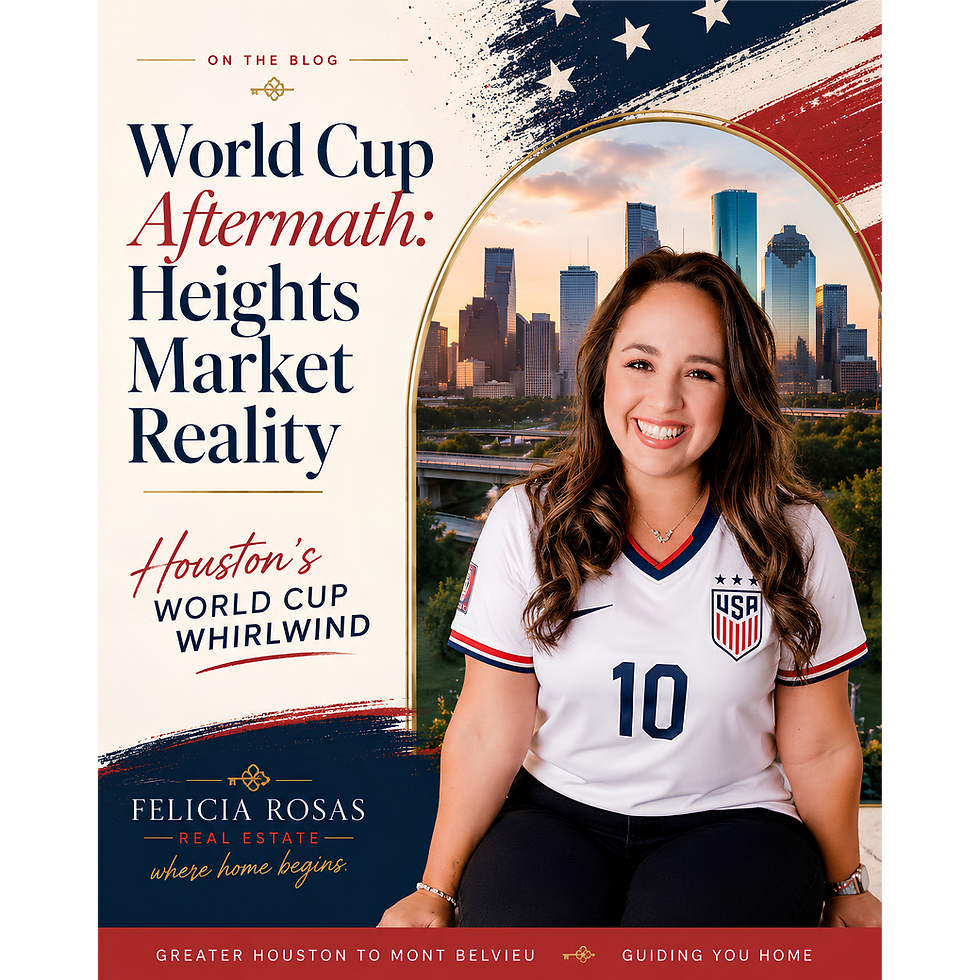
World Cup Aftermath: Houston's World Cup Whirlwind

If you live in the Heights, Montrose, Midtown, or anywhere inside the Loop, you've spent the last few months dodging orange cones, watching hotel shuttles roll down streets that used to be quiet, and maybe eyeing that "SOLD OUT" Airbnb calendar on your neighbor's house and wondering if you missed some kind of gold rush. Now that the final whistle has blown, a lot of my clients and neighbors are asking me some version of the same question: what just happened to my neighborhood, and does it actually change what my house is worth?
I've been watching this one closely, because I live it too. Here's the honest answer, not the hype.
The Short Version: The Hype Was Bigger Than the Bump
Let's start with what didn't happen, because it matters just as much as what did.
Houston hosted seven World Cup matches this summer, and the projections going in were enormous — an estimated $1.5 billion in economic impact and roughly 500,000 visitors, according to Houston's host committee. Hosts on Airbnb were told to expect around $3,000 in earnings just from the tournament window, and some short-term rental operators built entire strategies around it.
It didn't fully materialize that way. A Houston Public Media report from just this week (July 22, 2026) quoted Sébastien Long, president of the Texas Short-Term Rental Association, saying flatly: "We thought it was going to be a complete blockbuster, our best month ever. But it wasn't." International visitor numbers came in close to flat compared to last year, and several hoteliers told reporters they hadn't seen the return on investment they expected from hosting.
I'm telling you this first because it directly answers the question underneath the question. If you were hoping this article would tell you to rush your house onto the market to cash in on a temporary demand spike — that spike was smaller than advertised, and it's already fading. If you were worried you'd missed some window that's now closed forever, you didn't. The market did not go on a World Cup-fueled joyride, up or down, and that's actually good news for anyone trying to make a clear-headed decision about their home.
Here's what the numbers in the Heights actually show as of the most recent update (Zillow, data through June 30, 2026): the average home value sits at $616,629, down 1.2% over the past year. Citywide, the Houston Association of Realtors' June 2026 report shows single-family home sales up 3.5% year over year, pending sales up 12.3%, and inventory at 5.6 months — the most balanced this market has been in years, with median price holding flat. None of that reads like a speculative bubble. It reads like a normal, healthy market that happened to host a very large party.
What Actually Did Change — and Why It's the Better Story
Here's the part I actually want you to walk away remembering: the real upside for our neighborhood was never going to be a two-month rental spike. It's the permanent stuff that got built to make the tournament possible in the first place, and that stuff isn't going anywhere now that the cameras have left.
A few concrete examples, straight from local reporting on the buildout:
Downtown's Main Street Promenade — a $17 million project that wrapped up ahead of the tournament, converting seven blocks of Main Street into a pedestrian-friendly corridor with new shade structures, landscaping, and public plazas.
METRO transit expansion — upgrades aimed at making it genuinely easier to live car-lite inside the Loop, not just during the tournament but for years after.
Walkability and beautification work across Inner Loop neighborhoods, including improved pedestrian crossings, shade trees, and lighting in areas like Midtown and EaDo, with similar attention paid to Heights corridors.
None of that disappears when the last visitor flies home. If you own a home in the Heights or Inner Loop, you now live somewhere with better sidewalks, better transit access, and a genuine moment of global visibility that didn't exist eighteen months ago. That's the kind of thing that tends to support long-term desirability — not because of a headline number, but because it makes daily life in the neighborhood a little better, which is exactly what tends to keep buyers interested in a location for the long haul.
I want to be careful here and say clearly: this is my own read on the local market as someone who works in it every day, not a guarantee of future value. Real estate doesn't move in straight lines, and infrastructure investment is one factor among many. But if you're trying to figure out whether the last few months changed anything real about your neighborhood, my honest answer is yes — just not in the way most of the headlines promised.
What About Short-Term Rentals, Longer Term?
Here's my own professional opinion, separate from the World Cup conversation specifically: if your subdivision or deed restrictions allow it, a short-term rental inside the Loop is a genuinely defensible long-term play — not because of the tournament, but because of what's always been true about the location. Toyota Center sits downtown, and NRG Stadium is about a 10-minute drive from there, which means most Inner Loop neighborhoods, including the Heights, Montrose, and Midtown, are roughly 10 to 15 minutes from both. That's Texans games, the Houston Livestock Show and Rodeo, Rockets games, and the concerts and touring shows both venues host, all year long — a real, recurring calendar of demand, not a two-month tournament window.
The caveat matters just as much as the opportunity, though. As of January 1, 2026, the City of Houston requires every short-term rental operator to hold an annual certificate of registration ($275 plus an administrative fee), with enforcement underway. But that city registration does not override your neighborhood's deed restrictions or HOA governing documents — many Houston subdivisions prohibit short-term or transient rentals outright, and a Texas Supreme Court ruling earlier this year (the Tarr decision) reaffirmed that HOAs can enforce those restrictions even against a listing that's fully registered with the city. Before you count on rental income as part of your home's value, pull your specific deed restrictions or check with your HOA first. If your property is clear to operate one, the venue proximity is a real, lasting advantage. If it isn't, no city registration changes that.
So What Should You Actually Do With This?
If you're a homeowner in the Heights or Inner Loop, here's the practical takeaway: don't let a temporary rental-rate spike (or the fact that it fizzled) change how you think about your home's value. Price and position your home based on where the market actually is — balanced, steady, with inventory finally giving buyers room to breathe — not on a tournament that's already receding in the rearview mirror.
If you're a buyer who's been waiting on the sidelines wondering if you missed your window, you didn't. The data doesn't show a World Cup premium baked into current prices, which means the fundamentals still matter more than the moment.
Frequently Asked Questions
Did the World Cup make Heights home values skyrocket? No. The most recent data shows the average Heights home value essentially flat to slightly down year over year, and citywide prices have held steady rather than spiking. Whatever demand the tournament created didn't translate into a broad price surge.
Should I list my home right now to cash in on World Cup demand? I wouldn't recommend making a listing decision based on tournament timing at this point. The short-term rental and hotel demand that some homeowners hoped for came in well below projections, according to local reporting, and that window is closing regardless. Price and list based on the current balanced market conditions, not on a temporary event.
Is short-term rental income still worth considering for my Heights home? In my professional opinion, longer term, yes — if your subdivision allows it. Proximity to NRG Stadium and Toyota Center means a recurring, year-round calendar of games, rodeo season, and concerts, not just a two-month tournament. I'd still caution against assuming World Cup-level rates are the new normal, since several experienced local hosts said that specific spike came in well below projections. And before counting on any rental income, confirm your deed restrictions and HOA rules actually allow it, and register with the City of Houston — a listing can be fully registered with the city and still violate your HOA's restrictions.
What actually changed permanently in my neighborhood because of the tournament? The infrastructure — expanded transit access, walkability improvements, and public space investment like the Main Street Promenade downtown. Those are the pieces likely to matter for how the neighborhood functions and feels for years to come, independent of anything tournament-related.
How do I know what my home is actually worth right now, separate from all the World Cup noise? The only reliable way is to look at real, current comparable sales in your specific pocket of the Heights or Inner Loop, since even neighboring streets can behave differently. That's exactly the kind of conversation I'm happy to have any time.
A Quick, No-Pressure Next Step
If you're curious what any of this actually means for your specific home — not a citywide average, but your street, your square footage, your situation — reach out. I'm always happy to walk through it with you, no obligation attached.
Felicia Rosas, Broker Associate, Realty of America, LLC — TX License #657326 This article reflects general market observations and the author's professional opinion; it is not a guarantee of any property's current or future value. For advice specific to your situation, please consult directly.


Comments